
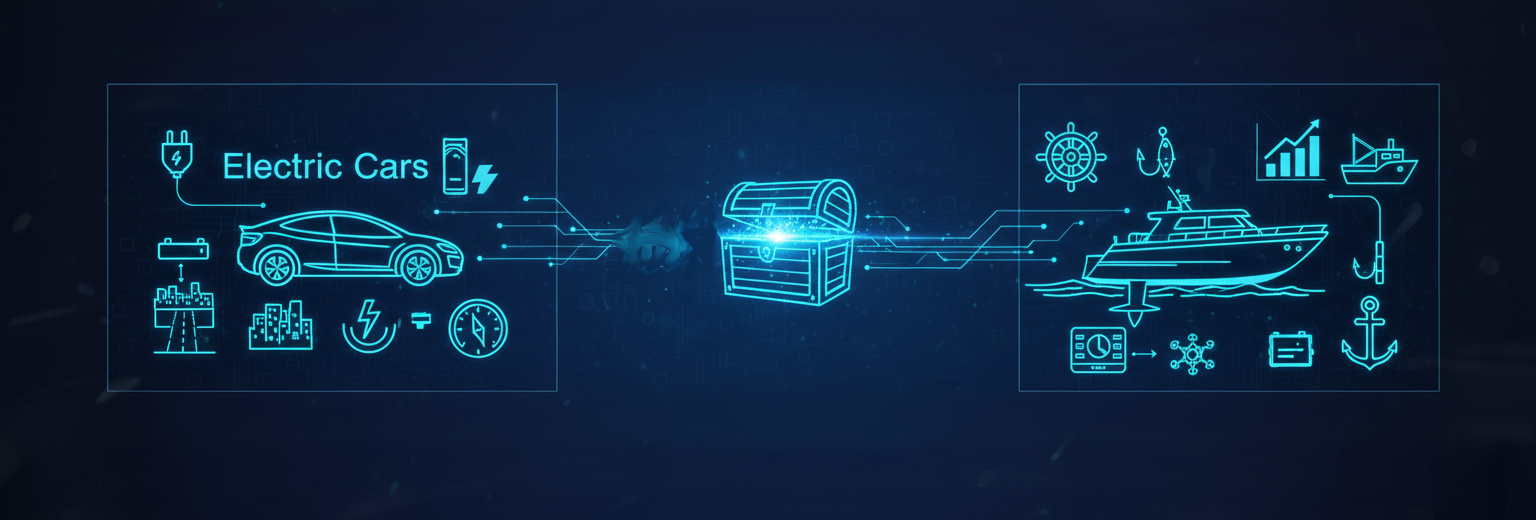
The Blue Treasure: Why Electric Boats Are a Smarter Bet Than Electric Cars
Imagine you want to build a gas station. Would you build it on a highway where cars might randomly stop, or inside a gated parking lot where 500 trucks park every single night?
Investors are making a biased mistake. They look at electric cars and see problems: drivers are scared of running out of power (“Range Anxiety”), and charging stations often sit empty. They assume electric boats have the same problems. This is a “pattern matching” mistake.
1. The “TripTimers”:
When you drive a car, you can go anywhere. That makes it hard to guess how much battery you need. For a fisherman is different. He has basically two timers: Ice and fuel. A small boat carries a box of ice to keep the fish fresh. The fisherman must return to port before the ice melts, or his catch will spoil; the subsidized fuel available for the fishermen is scarce and limited, dictating the viable trip distance.
Water taxis run like buses: same time, same route, every day. This means that trip distances are fixed and predictable. We don’t have to guess the range; we know it. The battery is sized exactly for that trip.
2. The “Weather Schedule”
Cars charge randomly. Boats operate on a schedule dictated by nature.
The operation of small boats in Indonesia is strictly governed by the Monsoon seasons (Musim Barat and Musim Timur). Empirical studies of Indonesian fishers show that they may only achieve between 145 and 175 “sea days” per year, adding fatigue and fuel availability. it means that a typical cycle is 1 day at sea, 1-2 days in port.
3. The “Captive” Customer
Electric car chargers are scattered around cities, “waiting” for random drivers. Marine chargers are different. They “farm” the same customers every day. In Indonesia, fishing boats don’t park in driveways; they all park in the same Port (Pelabuhan) or landing beaches (Pantai). They are “captive.” They have nowhere else to go. This guarantees that the charging station is used constantly, generating steady and predictable money, instead of waiting for a random car to show up.
4. The Solar Canopy hidden asset
This is the “secret weapon.” Traditional Indonesian boats (jukung) have long bamboo arms (outriggers) on the sides to keep them steady. These arms make the boat very wide—much wider than a car. This allows Gempacs to install a massive solar canopy (up to 3,000 Watts), light in weight, on a relatively small eight meters boat.
The Result:
The boat makes its own fuel from the sun while it fishes. It’s like a car that refills its own tank while you drive! This saves money and puts less strain on the electrical grid, making the gempacs solution somehow independent from it.
The Verdict:
Investing in electric car chargers is a gamble on what drivers might do. Investing in Gempacs’ charging infrastructure is betting on what fishermen must do. The boats are there, the sun is there, and they need the power to earn a living. It is a simple, secure, and sunny opportunity.